These reading statistics compile the most-cited, recent indicators on how often people read, how much time they spend reading,
and how the book market (print + audiobook) is performing. You’ll find reading statistics for adult literacy, reading for pleasure,
U.S. reading behaviors, and publishing market numbers—plus copy/paste charts and tables for WordPress.
Top Reading Statistics (Quick Highlights)
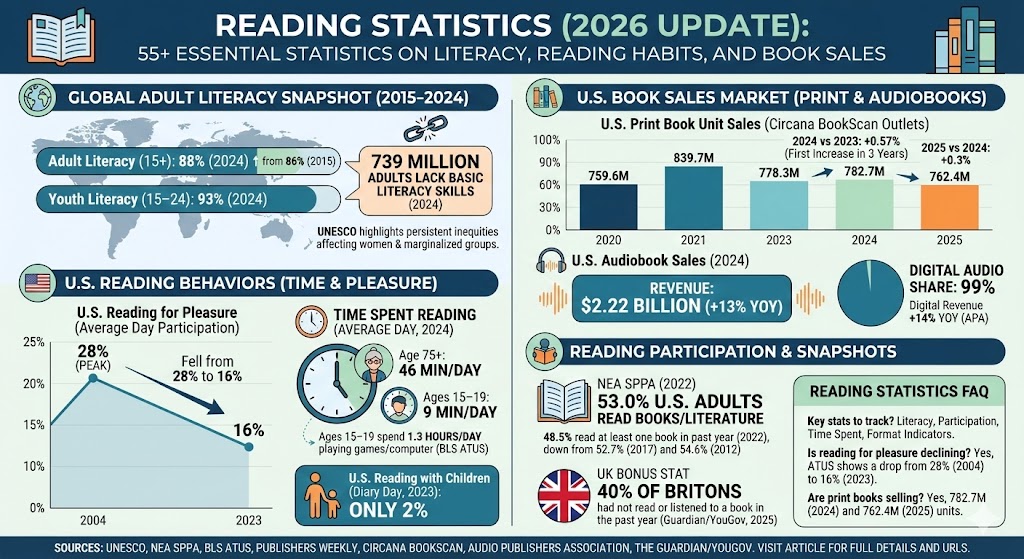
- Global adult literacy rose from 86% (2015) to 88% (2024).
- Global youth literacy (ages 15–24) reached 93% in 2024.
- 739 million adults still lacked basic literacy skills in 2024.
- U.S. adults reading for pleasure on an average day fell from 28% (peak in 2004) to 16% (2023).
- In 2023, only 2% of U.S. participants read with children on the diary day (ATUS-based study).
- U.S. print book unit sales: 782.7M (2024) vs 778.3M (2023).
- U.S. print book unit sales: 762.4M (2025), up 0.3% vs 2024 (BookScan outlets).
- U.S. audiobook sales revenue reached $2.22B in 2024 (+13% YoY), with 99% from digital audiobooks.
- NEA SPPA (2022): 53.0% of U.S. adults read books and/or literature.
- BLS ATUS (2024): people age 75+ read 46 minutes/day vs ages 15–19 reading 9 minutes/day (average day).
Reading Statistics Snapshot Table
| Category | Reading Statistic | Latest Value | Year |
|---|---|---|---|
| Global literacy | Adult literacy rate (15+) increased from 86% (2015) to 88% | 88% | 2024 |
| Global literacy | Youth literacy rate (15–24) | 93% | 2024 |
| Global literacy | Adults lacking basic literacy skills | 739 million | 2024 |
| U.S. reading for pleasure | Share reading for pleasure on an average day (peak vs latest) | 28% → 16% | 2004 → 2023 |
| U.S. reading with children | Share reading with children on the diary day | 2% | 2023 |
| U.S. arts participation (NEA SPPA) | Adults who read books and/or literature | 53.0% | 2022 |
| U.S. time use (BLS ATUS) | Minutes reading/day (age 75+ vs age 15–19) | 46 vs 9 | 2024 |
| U.S. print book market | Print units (BookScan outlets) | 782.7M | 2024 |
| U.S. print book market | Print units (BookScan outlets) | 762.4M | 2025 |
| U.S. audiobook market | Audiobook revenue + digital share | $2.22B (99% digital) | 2024 |
Reading Statistics Chart: Global Literacy Rates (Adults vs Youth)
Global Reading Statistics and Literacy Statistics
Many “reading statistics” begin with literacy—because literacy determines how large the potential reading population can be. The latest global
literacy snapshots show slow progress at the world level, but very large gaps by region and by gender.
- Global adult literacy (15+): 88% in 2024, up from 86% in 2015.
- Global youth literacy (15–24): 93% in 2024.
- 739 million adults still lacked basic literacy skills in 2024.
- UNESCO highlights that literacy gaps remain “inadequate and uneven,” with persistent inequities affecting women and marginalized groups.
Global Reading Statistics: Key Numbers to Quote
Reading Statistics Chart: U.S. Reading for Pleasure (Average Day Participation)
The cited study reports a peak of 28% (2004) and 16% (2023).
U.S. Reading Statistics: Reading for Pleasure and Reading Habits
A key set of reading statistics tracks whether people read at all on a typical day. The American Time Use Survey (ATUS) diary method is
especially useful for “behavioral reading statistics” because it measures what people actually did on a given day, not what they remember doing.
- 16% of participants read for pleasure on the diary day in 2023, down from a peak of 28% in 2004 (ATUS-based analysis).
- Average time reading for pleasure in 2023 was 16 minutes across all participants (including non-readers on that day).
- Among those who did read for pleasure in 2023, the study reports an average of 1 hour 37 minutes reading time.
- Reading with children was rare on the diary day: the study reports 2% read with children in 2023.
- 94% of reading for pleasure happened at home (own home or others’ homes) among those who read in 2023 (study detail).
Reading Statistics Insight
The same ATUS-based research notes a long-run decline in the share of people who read for pleasure on an average day, while the time spent by those who do read
rose—meaning the population of readers may be shrinking even as committed readers remain highly engaged.
Time Spent Reading Statistics (U.S.)
“How long do people read?” is one of the most requested reading statistics. BLS ATUS summary results highlight large age gaps in reading time.
- Age 75+ read 46 minutes/day on an average day (ATUS 2024 summary).
- Ages 15–19 read 9 minutes/day on an average day (ATUS 2024 summary).
- By contrast, ATUS 2024 summary notes ages 15–19 spent 1.3 hours/day playing games or using a computer for leisure (context for reading time competition).
Reading Statistics Chart: U.S. Print Book Sales (Units, BookScan Outlets)
Book Sales Reading Statistics (Print Books and Audiobooks)
Book sales are a practical companion to “reading statistics” because sales reflect demand for reading formats. Here are the most cited
U.S. book market reading statistics for print and audiobooks.
Print Book Sales Statistics (U.S.)
- 782.7 million print units sold in 2024 (year ended Dec. 28, 2024) vs 778.3 million in 2023.
- Publishers Weekly notes 2024 was the first annual increase in three years for BookScan reporting outlets.
- Print sales in 2024 remained below the 2021 peak of 839.7 million units.
- 762.4 million print units sold in 2025 (year ended Dec. 27, 2025), a 0.3% increase vs 2024 per Publishers Weekly summary.
Audiobook Reading Statistics (U.S.)
- U.S. audiobook revenue reached $2.22 billion in 2024, up 13% year over year (Audio Publishers Association survey).
- Digital audiobooks accounted for 99% of revenue in 2024, and digital revenue grew 14% year over year (APA).
Reading Participation Statistics (NEA SPPA)
Another widely used set of reading statistics comes from the National Endowment for the Arts (NEA) Survey of Public Participation in the Arts (SPPA),
conducted with the U.S. Census Bureau. It measures the share of adults who read books and/or literature.
- 53.0% of U.S. adults read books and/or literature in 2022 (NEA SPPA comprehensive report).
- NEA commentary on SPPA notes 48.5% of adults reported reading at least one book in the past year (2022), compared with 52.7% five years earlier and 54.6% ten years earlier.
- NEA commentary also notes 37.6% read a novel or short story in 2022 vs 41.8% (2017) and 45.2% (2012).
Reading Statistics (UK Bonus)
International reading statistics often show similar patterns: a large minority reports not reading books in a year, while frequent readers remain very active.
- A Guardian report on a YouGov poll said 40% of Britons had not read or listened to a book in the past year.
Reading Statistics FAQ
What are the most important reading statistics to track?
The most important reading statistics are (1) literacy rates (who can read), (2) participation rates (who does read),
(3) time spent reading (how long people read), and (4) format indicators (print vs audiobook vs digital). This article includes all four types of reading statistics.
Is reading for pleasure declining in the U.S.?
Yes, ATUS-based reading statistics show the share reading for pleasure on an average day fell from a peak of 28% (2004)
to 16% (2023).
Are print books still selling in large volumes?
Yes. U.S. print book reading statistics from BookScan outlets show 782.7M units in 2024 and 762.4M units in 2025.
Sources (Exact URLs)
- https://www.unesco.org/sites/default/files/medias/fichiers/2025/09/ild-2025-factsheet.pdf
- https://www.arts.gov/sites/default/files/SPPA_Comprehensive_Report_FINAL.pdf
- https://www.arts.gov/stories/blog/2024/federal-data-reading-pleasure-all-signs-show-slump
- https://pmc.ncbi.nlm.nih.gov/articles/PMC12496190/
- https://www.ucl.ac.uk/news/2025/aug/proportion-americans-reading-pleasure-fell-40-over-20-years
- https://www.bls.gov/news.release/atus.nr0.htm
- https://www.publishersweekly.com/pw/by-topic/industry-news/publisher-news/article/96842-print-book-sales-saw-a-small-sales-increase-in-2024.html
- https://www.publishersweekly.com/pw/by-topic/industry-news/financial-reporting/article/99417-print-book-sales-rose-slightly-in-2025.html
- https://www.audiopub.org/surveys
- https://www.publishersweekly.com/pw/by-topic/industry-news/publisher-news/article/97920-audiobook-sales-rose-13-in-2024-to-2-2-billion.html
- https://www.theguardian.com/books/2025/mar/06/new-poll-finds-40-of-britons-have-not-read-a-book-in-the-past-year